Showing posts with label poultry. Show all posts

Saturday, June 15, 2013

Cotton Patch Geese - a New Chapter :)

OH YES! We are now the proud parents of a pair of RARE Cotton Patch Geese! You may read more about them here: Cotton Patch Geese  They are basically a breed native to the south, well adapted to our climate, and they LOVE to eat weeds! PERFECT! Also, a fairly docile breed that is good at parenting - PERFECT again! The best part in so many ways is that they are easily sexed just by looking! Sure, I have learned and conquered how to vent sex ducks and geese (it's pretty easy actually) - but if you are gonna be letting mama's hatch their own eggs it's SO much easier to be able to tell boys from girls by looking then it is to have to catch them up and sex them individually!  And did I mention how well behaved they are??? Perfect birds!

Tonight, for now, they have no names yet - still trying to decide - but here they are on lockdown close to the house:
Tomorrow or the next day they will be shuffled to the "goose hut" and allowed to acclimate to it.  Expect babies next spring - geese aren't like chickens, they don't lay an egg everyday all year long and especially not these geese!

Thanks to our friends at Nonesuch Farm - the Parker family has some really beautiful stock on beautiful property and just a very few left right now!

This is a heritage breed - not hatchery stock, heck I don't even know a hatchery that has them yet - and being rare we would like to source one more unrelated pair to bring in so babies can be mixed from hatches to make pairs for other farms. So far, they have settled down, and are pretty friendly. The whole ride home, when we would talk and laugh THEY would make noises and chatter back! Pretty cool birds right there!

I expected them to be freaked out and hissy - but nope, none of that. REALLY calm for geese! These little babies are actually a few months old now (geese grow FAST) but they are still really just that - BABIES! So sweet and the best part, though it is hard to see, the male (or GANDER to be correct) has BLUE EYES! Yup, like I said, in pictures, not easy to spot - but pinkish feet and bill with blue eyes - just so good looking!

True highlite of my day right here....the most perfect geese ever :) But why do I call this a new chapter? Well, because I made a promise to myself back on the first of January that the ONLY breeds of birds I would be bringing in from here on out would be heritage birds! I will admit, that has been hard to do! Ideal Hatchery is ALWAYS advertising specials and those little fluffy brand new babies sure are cute! But I have won the battle NOT to buy them so far and I will continue to fight :P Yup, sure, I have THREE none heritage hens FOR EGGS ONLY....I won't be breeding or hatching anything from them, they are production for the household and nothing more. But from now on I will only keep heritage stock bought from other breeders with fine stock - sure hatcheries like Metzer can have some pretty nice fowl themselves - but I want birds that are true to the standards, birds that need a little help getting the population built back up.

The other promise I made to myself was to stick to JUST ONE breed for every type of bird. I had to REALLY think about it and narrow it down to just one breed of goose - they say most small farms drown in craziness and flop because they have way too much going on. Sure I would like to have a million of them roaming the property - but I can't, I am only one person and that kind of time keeping on eye on everything would drive me nuts! So I narrowed it down and stuck with one breed I could work with to keep, improve (not that these 2 really need it  LOL) and have to offer each spring. I picked these for so many reasons - they basically feed themselves when allowed to free range, they SHOULD basically brood and hatch their own eggs, and all I need to do is keep an eye on them to stay healthy and safe from predators - total can do. Geese really are low maintenance fowl compared to other things like chickens....a good place to start when you are really trying to get something nice and unique going with your poultry!

Now, we wait for spring to get here! It's going to be a LONG hard wait LOL! But worth it...I can't wait to see her first hatch following her around the property! AND NAMES! These two need names....so many good ones...hmmm....what shall we call them.....

Saturday, May 18, 2013

A farm needs chickens....


Actually, that is mostly my opinion...I'm sure there are plenty of "real farms" out there that are chicken free.  But to me, a farm MUST have at least a few chickens!  Since the great downsizing and reorganizing of things around here, we have been chicken free....and that just will not do! I have missed my poultry a great deal :(

I love to watch them peck and scratch their way through the yard - like when they are hunting and zone in on a specific bug, I LOVE the way they run, and I most especially enjoy "the egg song".  If you have never heard the egg song, well, you just ain't livin'! See, except for a few sneaky hens, when a hen lays an egg she sings and makes noise and you can ALWAYS tell there is a fresh warm egg waiting for you (if you listen enough times you can also tell WHICH hen it was)....I don't know WHY they do this, I just know THAT they do this.  I have asked them why, and no one's talking :(

Anyways, I had been missing the egg song something fierce (and the fresh eggs that come with it) when I stopped in the feed store this week....oh yes, those devils had baby chicks!  I ALMOST did it...almost bought some...but I had soap class and other things to get to that day and no baby chick time....

And let's never mind the CONSTANT specials I get emails about from the nearest hatchery...oh yes, I am on their mailing list and they are VERY tempting themselves! However...I just am not in the mood for TWENTY of anything right now.  That's a lot of chickens, and with the soap stuff taking off, breeding around the corner and possibly starting to show the goats too...well...I just don't have quite that much energy you know....

So THEN I ran into Conroe today, about an hour away, and stopped at the only place even remotely close that carries the minerals I prefer for my goats...and THEY had baby chickens!  Now...while standing there eyeballing my options....here comes the owner (who knows I am the crazy goat lady) and I asked when and if they would be getting any of a few certain breeds in...and GUESS WHAT...no really, guess....
 Meet Eeeny, Meany, and Miny....Moe (when I find one) will be the rooster haha!
Yes, they are barricaded in....this is to teach them where to sleep :)  A farm is only a real farm with chickens you know!

Yup - they have grown (but still young) hens available at a VERY reasonable price! These ladies are about 20 weeks old, JUST starting to lay with a long, productive life ahead of them! I stuck with 3 because it was a nice number - if one should not make it I still have two left thus avoiding a single lonely hen.  If all 3 are just fine after a few days then I am in heaven.  Sometimes the move can be stressful on them...so you cant count eggs before they hatch OR birds before they acclimate to a new place!

For now, they will spend a week or so on lock down in THEN when they know where to sleep and lay and find lunch, I will remove the blockade in the day time...that front piece is set up for easy access for them but NOT for other things (like the goats or pig who would cheerfully eat the chicken feed LOL).

After a long, busy day of running around, and a soap class, I was happy to come home and see them all asleep and doing fine :) And VERY happy because I have chickens again!  What are they you ask?  These are "red stars" which is just another name for a red sex link chicken...layers of brown eggs and much clucking to come!  Now we need just one rooster...I MISS my rooster crowing!  Maybe in a few weeks I will go on a rooster search...until then I am content to have my ladies :)


Thursday, March 21, 2013

Sourcing Seeds for Fodder...

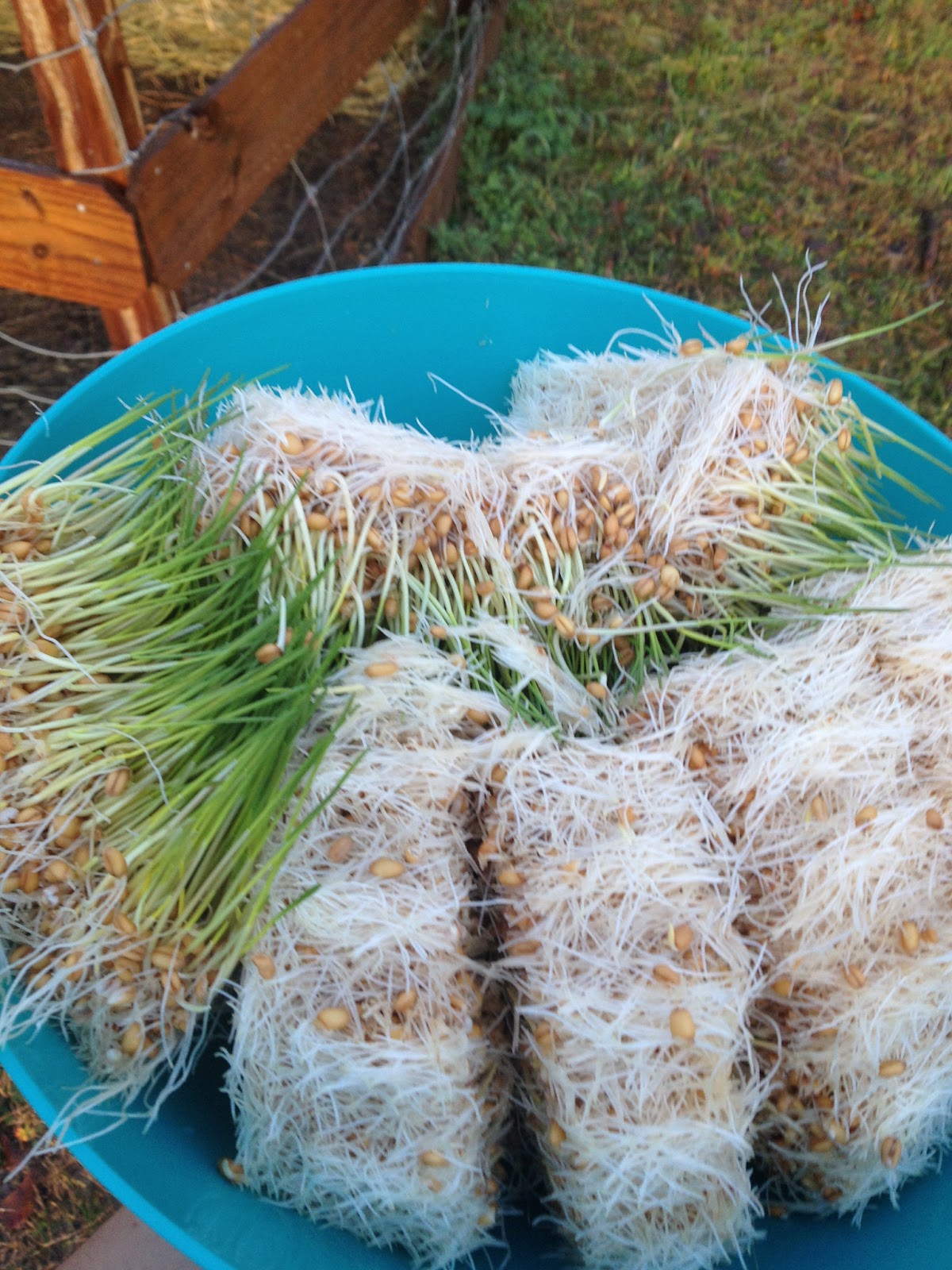
The first thing I did when preparing for my fodder trials was clear out a spot in the mudroom to actually grow the stuff, and then I gathered a few trays that would work.  Seeds however were a bigger challenge....

Here in Texas,. barley is not nearly as common or easy to come by as it is in other regions of the U.S.  This posed a problem - everyone was talking about BARLEY fodder...okay...so I looked and researched some more...It seems people also use a product from Tractor Supply called "Plot Spike" - it is meant to be tossed out in the woods and such on deer leases to get stuff growing that deer will like to nibble on.  Deer and goats being so close in so many ways, I knew that I could, if need be, sprout this stuff...but it was pricey! One major point was to bring down costs right?  Plus, I intended to feed this fodder to our horses and they are very much NOT like deer right? Okay...

So then I discovered that WHEAT would grow as well....okay...still not all that easy to find...but I DID find it!

A tip for those in Texas growing fodder...if your feed store carries Boyce products, ask them to order the Wheat.  It grows BEAUTIFULLY! Now, what if you aren't in Texas or can't get the Boyce products?

Well...call around....Human Health Food Stores - ah ha!  They carry organic and often non GMO as well barley AND wheat for sprouting and grinding into flour and such!  It will cost you a little more, but to me it is worth it.  Plus, the most local to me place will order it in bulk and offers a discount if they do that for me.  Pretty nifty right?

Call local or near as you can find local grain elevators.  They often can help you and point you the right way.  Call the other feed dealers.  Here we have Lone Star, MG, and a few others...the rep at Lone Star actually told me about Boyce...see...they CAN be helpful even if it is not their product!  They aren't out to be jerks, and can point you the right direction.

I actually called around for a friend yesterday.  She lives a few hours away from me, but still here in Texas.  First, I called Boyce and asked who the dealers were nearest to her, and got their number.  Then I ended up on the phone with a very nice, if ill informed as far as fodder goes, gentleman who talked my ear off LOL :)  But he was super helpful, gave me the info I needed to pass along to my friend and SCORE!  She now has a good source for wheat!

It does take a little creative effort sometimes to find what you want.  Often, telling people what you are doing with it helps!  Don't be afraid to say that you are looking for something that you can grow into fodder.  Most people will be glad to help you and even intrigued as to what you are up to.  I can't tell you how many times I have had to stop and explain the basics of fodder itself when I was telling someone on the phone what I was up to and why I wanted whole wheat or barley.

So, lesson here is:  don't be afraid to let your fingers do the walking, pick up the phone, and exhaust all resources before you give up and don't get hung up on growing just one thing like barley!  I almost didn't even attempt this after hitting a few dead ends...but perseverance is the key :)

I had my wheat, I had a few supplies...and the trials began :)

Tuesday, March 19, 2013

Bio What????

Bio - Available:    the extent to which a nutrient or medication can be used by the body.

In this case the "nutrient" in mind is fodder in general.  Barley, wheat, doesn't matter what you sprout.  Just know that by sprouting it you change it's "bio-availability" and make it easier to digest for your livestock and that fact was a big part of the switch for us.  The way I picture this concept in my mind, though a bit gross, is to think of corn and do some comparing...

All fodder starts as a seed...let's use wheat fodder because that is what I grow...Now, wheat berries and kernels of corn are both seeds and are both edible.  I've never chewed on "wheat on the cob" because it doesn't exist.  But I HAVE eaten corn on the cob.  Guess what...if it goes in it has to come back out and kernels of corn often return as those same kernels don't they?  Yuck, yes, but the blatant honest truth isn't it? I imagine if I were to go boil some wheat and choke it down I'd get wheat back on down the line too...I don't know for sure...but I'm guessing this is what would happen.

Clearly, whole seeds are not the most bio-available form of what they contain if they return as seeds still right?  Okay...so we grind them up and make flour out of them.  Whole wheat bread AND corn bread both go in as bread and come back out as...well...you can't tell it was ever bread!  But you would think that since it is more bio-available in that form it's the best one for us right?  And thusly, if whole seeds are hard to digest, then we should grind them up and make them into pellets for our livestock just as we make breads out of these ground seeds for ourselves right?  WRONG!!!!

See, here's the thing....when any seed sprouts, it turns into a plant.  Livestock, in general, are plant eaters.  Horses, goats, cattle...they eat grass and green things not breads and muffins (they shouldn't at least). Their bodies are meant to chew, grind, and in the case of ruminants they ruminate that green stuff into nutrients their body can use.  Sure, they can survive and thrive on pelleted feed (which is like the livestock version of humans bread I guess).  But it isn't what they are meant to be eating.  Even ground up, it's harder for their bodies to get at the proteins and vitamins in there...now, turn it into greenery which they ARE designed for and you get a different result.  It is easy for them to break down into the vital bits and pieces they need to thrive and grow and produce. 

Heck, if you think about, breads in high amounts aren't really all that great for humans either.  If I eat a diet heavy in bread I gain unhealthy pounds of chub-a-dub-iness that's for sure...so when I finally grasped the fact that sprouting wheat into grass made the stuff in it my critters needed to be healthy available to them it made even more sense to switch to fodder.  Then I realized I myself needed to eat more veggies and less bagels, but that's another story isn't it? Basically, by growing fodder I am providing a diet with fresh veggies for my livestock instead of dingdongs and pretzels...hmmm....which way of eating is healthier?  The veggies I believe...

Needless to say once I had pondered this, I knew I wanted to give fodder a go.  I wasn't sure if it would fit in with our farm, and I was having a heck of a time finding the so highly revered barley seeds everyone speaks of using in their fodder systems...so the next step was locating something to sprout and seeing if I could handle it...plants tend to get forgotten around here.  They just don't cry for help when they need a drink of water like the pig does when he tips his bucket over ya know? But I was armed with some basic knowledge and ready to give it a try...once I found that dang barley!

Ahhh....fodder...the saga continues....tomorrow....:)


Sunday, March 17, 2013

Ok...so WHY Fodder???

Well...I choose fodder for a few reasons.  First and foremost it is more natural to what my livestock would eat if they had their own choice in things.  Sometimes, they do get a choice - we are on 10 acres after all - but at night they are stuck in their pens close to the house for safety and some days they are stuck there as well.  When it rains the back of the property turns to a bog I prefer them not to play in...plus they won't leave their shelter anyways in the rain, so they stay there. Also, the front is not yet fenced for the horses and NONE of it is properly fenced for goats (besides their pen areas)...so I try to get out there an hour or 2 a day and let them "free range" if you will - that's another blog post though...let's just say that no matter what after a few years of crummy drought conditions anyways I am always prepared to feed my animals plus dairy goats need to eat more than just browse if you want the best, highest yields on your milk...

Anyways, horses, goats, cattle - none of these things go out on the hunt for corn or soybeans in their pastures.  Sure, if they find it they will eat it - heck, they'll eat your garden if they get the chance!  But naturally the bulk of their diet is fresh GREEN stuff!  Grasses, weeds, shrubs...Pelleted feeds make a decent supplement to this (particularly if you are in a drought and there is nothing green left!), but it's not natural at all.  Especially for the goats...goats can get acidosis, or bloat, from things like a corn heavy diet. This article explains it a little better...  Let's be really honest here - go check a bag of pelleted goat or horse feed - a good portion of it is corn or soy.  It's certainly not fresh green stuff at all! So, if by chance an accident occurs and you over feed (like the day I fed and then my husband fed thinking I hadn't yet...that was a doozy) or if you just are over feeding and not realizing it...you are setting yourself up for failure in a way...We actually took the corn out of the goats diets a few years back now and have not had a case of "bloat" or acidosis since then, but it was not uncommon to run up against it from time to time before when we fed traditional goat feeds...

Then, there are our horses...over feeding pelleted feeds can lead to colic.  Too much bagged type feed and not enough roughage and you set yourself up for it - ask our friend who lost her beloved mare after making that mistake...plus it's much harder on their teeth and such to eat those pellets than it is to grind up some grass.  Sure, horses teeth are meant to grind and pulverize - GRASS - which is actually fairly soft, stringy but soft, compared to pelleted stuff - not hard like the pellets in bags are.  Since switching to fodder our middle aged gelding (17 years old - not ancient, but getting up there) has had a much easier time staying the right weight. (And yes, he has been properly wormed, had his teeth floated, etc...but you can tell his body processes fodder better).

That's the other thing - fodder is much more bio-available to the animals to digest...we'll save that talk for tomorrow though...

Then there are all the horror stories and recalls and what not in regards to processed feeds...This article hits very close to home and then there was my own mysteriously dropping poultry...these are just 2 examples of why you have to be careful what you feed your animals.

You also have the whole "non-GMO/organic" vs not side of the debate...it's still pretty easy to find and source organic type barley and wheat to sprout compared to finding organic feed (at least where I live).  Also, even though it may be more expensive to go the non-GMO route, it still is a money saver to sprout it into fodder...

Oh yes - one 50lb bag of seed turns into 250lbs of feed!  You still feed by weight, just as you should with pelleted type feeds, and you actually feed pretty closely to the same amounts.  You just get far more bang for your buck with fodder!  So, it's a money saver that's for sure...They also seem to go through less hay when you feed fodder.  YES, EVERYTHING still needs hay!  Those long, dry, fiber filled grassy bits help their digestion just as humans need the right amount of fiber in their diets.  But we are using less of it that's for sure! Here, during the winter, we were going through close to 2 square bales a day pre-fodder - now that I have made the switch, we are down to about one square bale a day and that will certainly be less as it greens up out there with spring coming on...but knowing next winter I will need less hay to get through is NICE!

 PRE-fodder, I was bringing home 8 to 10 50lb bags of feed every 2 weeks - even after I thinned the herd! Now, I bring home maybe 5.  My goats still get their alfalfa pellets for the calcium (we are a dairy herd after all and calcium out in the form of milk = needing calcium in to make more) and I need the pelleted stuff for the pig some days so I can soak it with whey and milk for him...otherwise he tips the bucket and spills it...messy thing!  I've basically cut my feed bill easily in half even including the hay!

So, without going all scientific on you just yet, that was my initial take on why we were going to switch.  It was more natural to what they would eat, FAR less processed and meddled with by humans, a way to cut back on the feed bill when I ran the numbers in theory (though now I know for sure), and a power packed form of feed that was easy to digest!  The next thing I had to do was look at it more in depth - it seemed like a good idea...but I had to do some more research..

If you go to the following blogs and websites, you will see some of the info I found and can read through it for yourself - these people have put TONS of time and effort into this and have some great material!

Paca Pride Guest Ranch has an awesome blog and videos!
Half Pint Homestead has tons of info and sells kits geared towards smaller producers (like us :) )
The facebook Fodder Group is full of people with tons of knowledge ready to answer any questions you may have!
Here and here are 2 more sites more geared towards the larger producers with their set ups...

Also...remember fodder works for pretty much everything, not just horses and goats....take a look and watch for more to come from me...you'll be amazed when you read through it all...

Thursday, March 14, 2013

The thining of the herd....Part 1

Back around the holidays between money being tight and the weather being so cold I was stuck inside...I found myself researching different ways to lower our feed bill.  With 2 horses and at that time 15 goats and 4 pigs and a half a dozen older chickens and another dozen meat rabbits of varying ages we had a pretty hefty feed bill.  Not to mention the fact that I had brought home some chicken starter crumbles a few months before as I HAD (had being the key word) some replacement laying hens which were about a month old still in the brooder....after serving them that bag of feed they literally half dropped dead in an hour and the other half wilted and wasted away over the course of a week...the dealer claimed up and down it wasn't them...I doubt it though...

I made a resolution well before the New Year arrived that I would do 2 things.  One - I would find a better way of feeding my animals, something healthier and sustainable for us.  Two - I needed to thin things out a bit.  It was just too time consuming to be caring for a yard full of critters AND try to make this place better than it already was...feeding and watering and such sucks up a LOT of time! That was time I could be spending improving things around here...so I began to thin the herd...
 
First I went through the easy stuff - small animals.  The rabbits were either getting up there in age or young fryer sized and to be honest we already had (and still have) quite a bit of rabbit meat in the freezer.  I sold some of the younger ones, stock that would be suitable for breeding as just that, and then I culled the rest for freezer camp.  I knew I had several does due to kid, projects a plenty to tackle, and I wouldn't have the time for rabbits for a while.  It was tough to do, as I enjoyed them and all of the fresh meat they brought to our table raised in a healthy fashion...but with the rabbits out the feed bill dropped a bit...


Then  came the pigs...we had a freezer full of pork products, and these were just pot belly pigs....not like I was loosing whole hams here.  So I sold all except one.  He was retained to do my garden tilling in the spring.  The others got the boot.  That wasn't so hard to do, except by the time the family that bought them found the house is was well after dark and took a little creativity in parking to shine headlight just so as to be able to find them...but that was another way to massively lower the bills...

Next came the chickens...and that was much harder than either the rabbits or the pigs!  Some of these birds were my original chickens and some were not.  I had a strange emotional attachment to poultry that I didn't have with the pigs or rabbits...but still, the job had to be done.  The younger group was sold to a friend and the older birds were quietly culled.  In all seriousness now, the older birds weren't hardly laying any longer and had not been for some time - the egg factory had dried up so to speak.  The younger ones were okay layers...but they had been given to me by another lady who was just hatching and raising backyard type birds.  They were nothing fancy and not overly productive anyways. I had already decided months prior that for my flock I wanted productive, strong layers.  I will admit, I miss my fresh eggs.  But it's been a nice break not having to mess with poultry these last few months and when I jump back in I will hopefully have everything set up just right and perfectly for them versus the half baked deal we were working with after our move....

So now I was down to just one pig, the horses and the goats...I debated for a while letting my mare go.  I love her, but to be honest the horses have become the red headed step children of the farm.  There was a time pre-goat where the horses were bathed once a week, ridden at least 3 times a week, and in general they were overly spoiled.  Now they are lucky to be ridden once a week, bathed 3 times a year, and they a get a fraction of the attention that the goats receive. I decided against it though - Smokey is my love and even if I don't give her the attention I used to she is still a one person type of horse and very attached to me and me alone.  And let's not even go their with Rocket.  First of all he is older and when I took him on it was decided this would be his permanent forever family - he had been through enough changing of hands in his life.  Not to mention that he is my husbands horse and I really do think Mr Homesteader would have a fit if I got rid of HIS horse...That left the goats...a story we shall save for tomorrow or the next day, but needless to say we dropped down to 10 goats as well....

So, anyways, back to the point being that I had time on my hands now that there were less critters to deal with, research to do, and a problem to solve.  I was tired of feeding overly processed mostly gmo corn based molasses filled pelleted feeds to everything with the added factor of the mysteriously dropping dead baby chicks...yeah, I'm still bitter about that (but that's another blog post entirely). Anyways...Dr. Google solved it for me in the form of FODDER!!!


Stay tuned...the saga continues tomorrow....


Wednesday, March 13, 2013

The mystery of the dead baby chicks...

This post is a look back in time, as the next one will be a fast forward to the future...it provides a bit of history and why to what I am up to.....I'll try to make a long story short for ya'll here...

Back in October I ordered 25 each of Golden Comet pullets and a mix of ducks.  The time had come to revamp and cull our existing small flock and look forward to having some serious eggs again.  We had about a dozen chickens all of which were getting older - like close to 3 which for a hen is old - and I wanted to add some ducks to the mix.  Duck is tasty and duck eggs are great for baking! When I saw that Ideal Poultry had a sale going on I went for it...(Ideal is close to us and they do a great job!)


Not the best pic, but there's my ducks...

They came, everyone except one was thriving and a month into it I had to go pick up a new bag of starter crumbles for them.  So, I did, I brought it home and into the dining room where I brood them and the next morning it went seriously down hill...

I got up as usual, cleaned out the brooders and refreshed their food and water the same as always - the only thing different was a new bag of feed.  The one I had just bought the day before.  Not a new type of feed - same brand they had been getting - just a fresh bag of it. Same feed mill, same feed store...so anyways, out I went to feed and milk the big critters.

An hour later I came back in the house to literally find almost half each of the ducks and chicks BELLY UP! Legs flailing in the air, kicking, struggling to survive...some already dead...I was devastated...I didn't know what to do for a minute.

As I pulled dead birds from brooder boxes I also pulled the water and food - water which everything else including the humans here had been drinking and nothing else was sick - and then it hit me.  NEW BAG OF FOOD!  I called the feed store, and at their insistence I brought back the bag of feed...I shouldn't have, I should have saved it and had it tested.  But I was too emotional to think about all that at the time. How could you not be when you see such vibrant young life literally snuffed out in an hour?

I also called the feed mill that afternoon once I was calmer from where the feed was made and do you know their comment?  And I quote "Let me know how that goes" the nutritionist tells me on the phone after I explain what had been happening and asked if they had made any changes to the formula or had any other calls...Not "I'm sorry for your loss"...just let him know how it goes...gee thanks, guess who will never ever over her dead body buy that brand again! (Also, I did let him know how it went, I packaged up a few dead birds and mailed them overnight to his office...was I mad?  Bitter?  Oh yeah baby, you bet..."That's how it went you baffoon, THEY DIED!!!" read the note I had written and placed in the box - what a moron...)

I got no apology, no I'm sorry, no money back on the feed which I tossed to be safe, and no refund on my poultry (which eventually except for one - yes just ONE - bird within a week they all died, even after switching to a different brand of feed) and get this:
Long story short the claim was there was nothing wrong with their product...yeah right...if your freshly bought bag of feed was the only difference in their little feathered day, how am I to truly believe it was not your product? Of course they claimed to have it tested for everything blah blah blah...great, because I unwittingly took it back for them to do that without reserving any for myself.  I was blind and naive to think I would get an honest answer as to what ever happened.  I do know I will never make that make again because the entire incident eventually led to another path for me to follow, a journey of sorts into fodder...

Stay tuned to see and hear more about our venture into a new method of feeding.  I made the switch because I was over producers and their attitudes.  Sure, you work there, you may own the company, and you THINK you have a great product - but clearly it was killing stuff here...I'll take my chances growing my own feed thank you!  And don't worry folks...I'll be getting more chickens soon...one day at a time right?

Monday, March 11, 2013

Boo to daylight savings time!

Yeah, that's right, you heard me.  I said BOO!  UGH! YUCK! But we get an extra hour of daylight you say, why do you hate the time change you say....Because in reality we do NOT get an extra hour of daylight - it's all a scam meant to mess up my schedule!

Yup...a scam, a sham, a flim flam floosy way of messing with my head.  The sun still rises and sets as it pleases.  Heck, in Arizona and Hawaii they don't even recognize daylight savings or have to change their clocks...why should I change mine?  Really, stop and think about it ya'll...

Yesterday, my critters were all ready half an hour before sunset to be fed.  It's the way we roll around here.  I wait until the last possible minute to get out there and feed since I am not an early riser anyways.  I promise you, the horses did not care about the time change.  Their internal clocks know when I will be out with dinner by the position of the sun.  However, when it comes to people stuff this is a pain!

I had a load of hay delivered yesterday - and I woke up all in a tizzy at 10a.m. (the old 9a.m.) thinking I had missed it! Thank you daylight savings time for giving me a minor heart attack.  Thankfully, I did not miss my hay guy calling and heading over.  But still...can you see how it affects my dealings with people? Never mind that I was seriously up all night until 3a.m. because I couldn't sleep which would only have been 2a.m. a few nights before...yup...daylight savings sucks in my opinion...

Now, while you're all excited about that extra hour of daylight, I want you to find a farmers almanac or google this. Actually, here's the link to the farmers almanac website:   sunrise and sunset times by city   Look up sunset and sunrise for Saturday (before the time change) and count how many hours of daylight there were.  Now look it up for Sunday (after the time change)....hmmmm....where's the extra hour now?  Can't find it can you? See...it's all a sham I say! There is no extra hour of daylight, just an unnecessary need to readjust our own clocks as well as our own biological clocks!  Crazy madness for no dang reason...

 Now I am finally headed out to make the rounds and get stuff settled for the day - it should only be 11:30 but it's after noon now...and nothing anyone can say will make me appreciate the falseness of an imagined extra hour of daylight today...I'm all backwards and running later than usual.  Thanks a bunch daylight savings time...NOT!!!!
 Yup, what he said....